
Learn Bitcoin
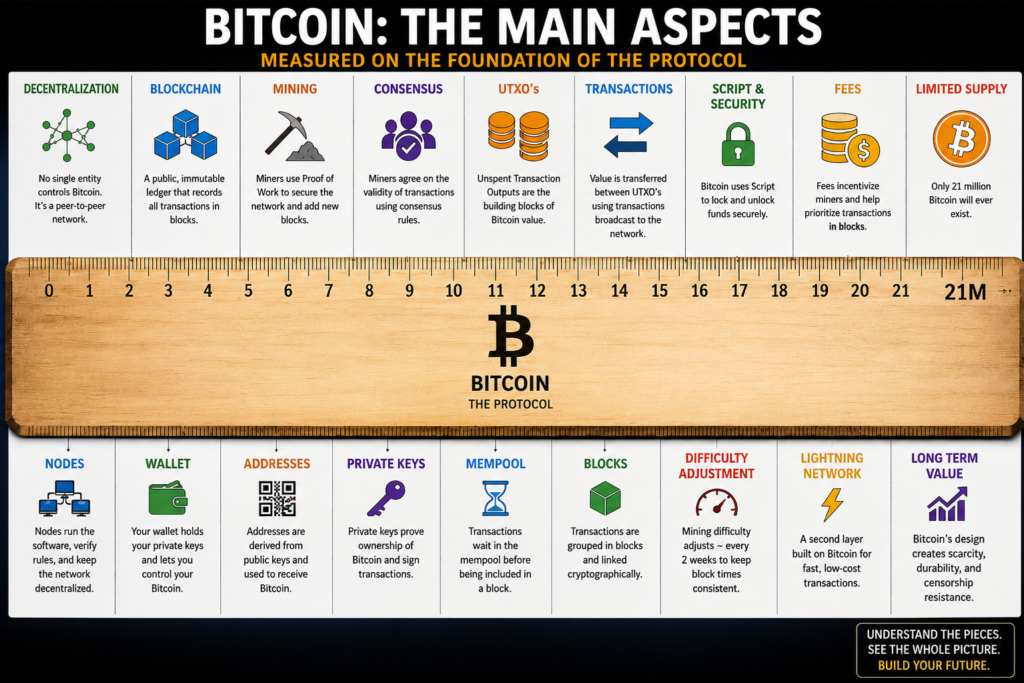
Bitcoin has a learning curve, but it’s not as steep as it looks. A key aspect of Bitcoin is starting in the right place and building your knowledge one layer at a time. This page is organized by level so you can start exactly where you are and work your way forward at your pace.
No technical background required. No jargon. Just clear explanations that build on each other the way Bitcoin itself does, one step and one block at a time.
Level 1 – The Basics
Start here if you’re brand new to Bitcoin. These are the foundational concepts every Bitcoiner needs to understand before going deeper.
What is Bitcoin? Bitcoin is a decentralized digital currency that operates without a central bank or single administrator. It runs on a network of computers around the world and allows anyone to send and receive value directly without needing a bank, payment processor, or government in the middle.
Why does Bitcoin matter? For the first time in history, people can store and transfer value in a way that no single person, company, or government can control, freeze, or inflate away. Bitcoin is scarce by design. There will only ever be 21 million Bitcoin, making it fundamentally different from traditional currencies that can be printed without limit.
What is a Satoshi? A satoshi is the smallest unit of Bitcoin, named after Bitcoin’s anonymous creator, Satoshi Nakamoto. There are 100,000,000 satoshis in one Bitcoin. You don’t need to buy a whole Bitcoin; you can own any fraction of one.
What is a Bitcoin wallet? A Bitcoin wallet is software or hardware that stores your private keys, the cryptographic proof that you own your Bitcoin. Wallets don’t actually store Bitcoin itself; they store the keys that provide you with access to your Bitcoin on the blockchain. Bitcoin never leaves the blockchain.
Level 2 – Going Deeper
Once you understand what Bitcoin is, these concepts will help you use it safely and intelligently.
Custody and self-custody. When you hold Bitcoin on an exchange, the exchange holds your private keys, not you. “Not your keys, not your coins” is one of the most important phrases in Bitcoin. Self-custody means holding your keys using a hardware or software wallet so nobody else can access or freeze your funds.
Hot wallets vs cold wallets. A hot wallet is connected to the internet, making it convenient for small amounts and regular use. A cold wallet (hardware wallet) is offline, making it much more secure for storing larger amounts over the long term. Most serious Bitcoin holders use both.
What is the blockchain? The Bitcoin blockchain is a public ledger of every Bitcoin transaction ever made. It is maintained by thousands of computers worldwide and cannot be altered. Anyone can permanently record and verify every transaction. Bitcoin nodes maintain the digital ledger, and anyone can run one.
What are Bitcoin fees? When you send Bitcoin, you pay a small fee to the miners who process your transaction. Fees are based on the data size of your transaction — not the dollar amount. This is why understanding UTXOs (unspent transaction outputs) matters. Your UTXO structure directly affects how much you pay in fees.
Level 3 – The Protocol
Ready to understand how Bitcoin really works? These concepts go deeper into the protocol itself.
What is Bitcoin mining? Mining is the process by which new Bitcoin transactions are verified and added to the blockchain. Miners compete to solve complex mathematical puzzles — the winner adds the next block of transactions and earns newly created Bitcoin as a reward. This process is called Proof of Work, and it is what secures the Bitcoin network.
What are UTXOs? UTXO stands for Unspent Transaction Output. Every time you receive Bitcoin, it arrives as a discrete unit of account — a UTXO. When you spend Bitcoin, you consume one or more UTXOs and create new ones as change. Your UTXO structure affects your fees, your privacy, and your long-term Bitcoin health. This is the topic covered in depth in The Jar on the Counter.
What is the Lightning Network? Lightning is a payment layer built on top of Bitcoin that allows near-instant, low-fee transactions. It works by opening payment channels between users that settle on the Bitcoin blockchain. Lightning makes Bitcoin practical for everyday small payments.
What is a Bitcoin node? A node is a computer that runs the Bitcoin software and maintains a full copy of the blockchain. Running a node means you don’t have to trust anyone else to verify your transactions — you verify them yourself. It is the ultimate expression of Bitcoin’s “don’t trust, verify” philosophy.
This knowledge base grows as Bitcoin evolves. New topics, more profound explanations, and updated content will be added regularly. If there’s a concept you’d like explained or a topic you can’t find answers to, reach out through our Contact page; your question might become the next article.