
So you’ve bought a stock or two. Maybe you own a little Apple, a slice of Tesla, or a share in an index fund your dad recommended. Good for you — you’re already ahead of most people.
Now you’re hearing about Bitcoin everywhere. Your coworker owns some. There’s an ad for it at the airport. And you’re wondering: is the product just another investment, or is it something completely different?
The honest answer? It’s both similar and very different. Here’s what you need to know.
What you actually own
When you buy a stock, you’re buying a share of a company — but here’s something most new investors don’t realize: you don’t technically hold that share yourself. A clearinghouse holds it on your behalf. In the U.S., that’s the Depository Trust & Clearing Corporation (DTCC). Your brokerage shows you the number, but they hold the actual ownership record. You own the value, but a middleman holds the asset.
That company still has employees, products, revenue, and leadership, and if it grows, your share becomes more valuable. Some stocks even pay dividends — a small cash reward just for holding them. But at the end of the day, you’re trusting the system to honor what’s yours.
When you buy Bitcoin and take self-custody—meaning you move it to your own personal wallet—it is truly, completely yours. No bank, no clearinghouse, and no brokerage that stands between you and your asset. There’s a saying in the crypto world: “Not your keys, not your coins.” But when those keys are in your hands, no one can freeze, seize, or lose them for you. Think of it like holding gold in your own safe, rather than storing it in a vault you don’t control.
Who controls it?
Stocks operate within a regulated system. The SEC oversees markets, companies must report financials, and your brokerage protects your holdings under established laws.
Bitcoin is decentralized. No government, bank, or company controls it. That’s a feature for some people—and a concern for others. There’s no authority to call if something goes wrong.
The risk factor
Stocks can be volatile, but they generally reflect real-world business performance. A well-run company in a growing industry tends to grow over time. However, there’s a risk many new investors overlook: a stock can be liquidated. If a company goes bankrupt or gets delisted, your shares can become worthless, and you can lose your investment entirely. It’s gone.
Bitcoin is significantly more volatile. It can gain or lose 20–40% of its value in a matter of weeks. That’s uncomfortable. But here’s an important distinction: if Bitcoin drops below what you paid for it, you still own it. The price went down — but the asset didn’t disappear. It can recover, and history has shown it often does. You’re riding the wave, not watching your investment disappear off the books. That’s a fundamentally different kind of risk than a stock that simply ceases to exist.
Liquidity and access
Both are relatively easy to buy today. Stocks are purchased through brokerages like Fidelity, Schwab, or Robinhood. Bitcoin is bought through crypto exchanges like River or Kraken, and increasingly through traditional brokerages too.
One key difference: Bitcoin trades 24/7. Stock markets close on weekends and holidays. Bitcoin never sleeps.
By the Numbers: 17 Years Side by Side
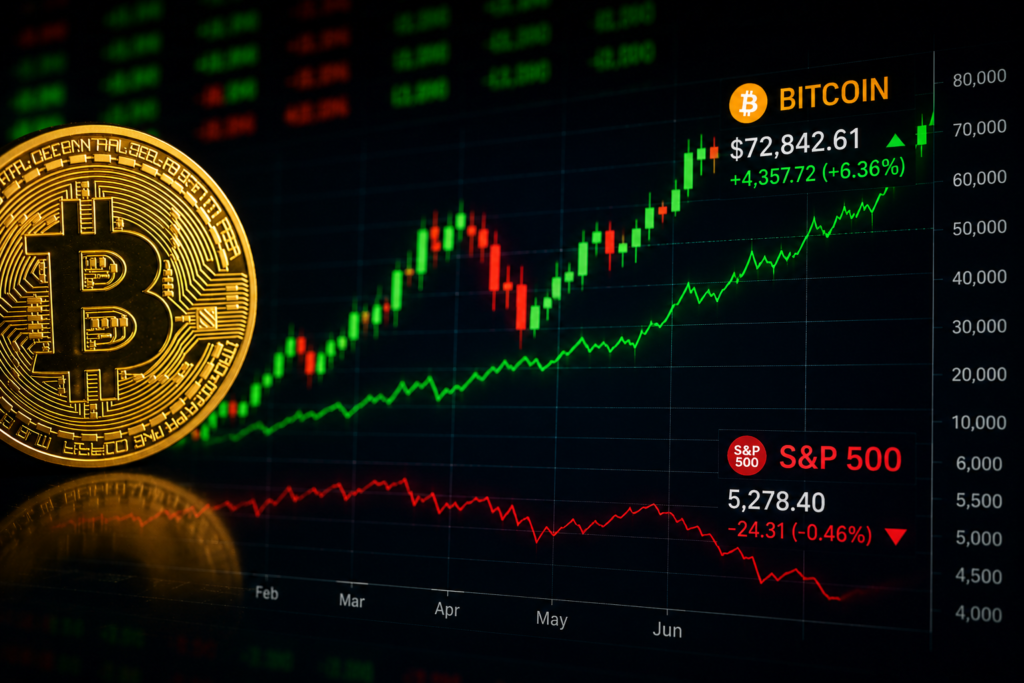
Sometimes the best way to understand two investments is to just look at what they’ve actually done. Here’s a real-world snapshot comparing Bitcoin and the S&P 500 from 2009 to 2025:
- $1,000 invested in the S&P 500 in 2009 would be worth approximately $8,000 today — a gain of around 700%. Solid, steady, reliable.
- $1,000 invested in Bitcoin in 2009 (at fractions of a penny per coin) would have grown to an almost unimaginable figure at peak value, well into the hundreds of millions of dollars.
- Even a more modest entry: $1,000 in Bitcoin in 2016 would be worth roughly $153,000 by early 2026 — a 15,000%+ return over 10 years.
- The S&P 500 averages about 10% per year over the long term. Bitcoin has averaged far higher, but with crashes of 60–80% along the way, that would test any investor’s nerves.
The takeaway isn’t that Bitcoin is “better.” It’s that the two assets operate under very different rules. The S&P 500 is the slow and steady tortoise. Bitcoin is a rocket ship with no seatbelt.
So, Which Is Better?
That depends entirely on your goals, timeline, and comfort with risk.
Stocks offer a time-tested path to building wealth tied to real businesses and economic growth. Bitcoin offers a newer, higher-risk, higher-potential-reward alternative that operates outside traditional finance.
Many investors hold both. Neither is inherently right or wrong—but understanding what you own is always the right place to start.
Ready to learn more? Explore the rest of Bitcoin4Newbies for plain-English guides on getting started, staying safe, and thinking like an investor.