Why Bitcoin: Understanding Value, Money, and the Case for a Scarce Digital Asset
Most people come to Bitcoin through a price chart. They see a number go up, they get curious, and they start asking, “Should I buy some?” But that question, while natural, skips over something far more important. Before you can understand why Bitcoin has value, you need to understand what value is, what money actually does, and why the system most of us grew up trusting has some serious flaws.
This isn’t a post about getting rich. It’s about understanding why a growing number of thoughtful people—economists, engineers, investors, and ordinary savers- believe Bitcoin may be one of the most important financial inventions in human history.
What Is Money, Really?
Money is not wealth. This is the first thing to understand. Money is a tool we use to measure and transfer wealth. A loaf of bread, an hour of skilled labor, a plot of farmland—these are real things with real value. Money is just the agreed-upon language we use to express and exchange that value.
Throughout history, humans have used all kinds of things as money: seashells, salt, cattle, glass beads, gold, silver, and paper. What made each of these work—for a time- was that people agreed they worked. The moment that agreement broke down, the money failed.
The best forms of money throughout history have shared a few key properties. They were scarce, meaning they had to be created from existing materials. They were durable, so they didn’t rot or rust. They were divisible, so you could make change. They were portable, so you could carry them. And they were difficult to counterfeit. Gold dominated as money for thousands of years primarily because it satisfied all these properties better than almost anything else available.
How We Got Here: The Story of the Dollar
The U.S. dollar wasn’t always what it is today. For most of its history, the dollar was tied to gold. You could, in theory, bring your paper dollars to a bank and exchange them for a fixed amount of gold. This was called the gold standard, and it acted as a natural brake on how much money the government could create—because you can’t print gold.
In 1971, President Nixon made the Nixon Shock decision to end the direct convertibility of dollars to gold. From that point forward, the dollar became what economists call a fiat currency—meaning its value rests entirely on government decree and public trust, not on any physical commodity. The word “fiat” comes from Latin, meaning “let it be done.” The dollar is valuable because the government says so, and we collectively agree to act as if it is.
The problem with fiat currency is that it can be created in unlimited quantities. And governments, facing wars, recessions, and political pressures, have a long track record of doing exactly that. Since 1971, the U.S. dollar has lost more than 85% of its purchasing power. That means a dollar today buys less than fifteen cents’ worth of what a dollar bought in 1971. The money didn’t disappear—it was diluted, quietly, year after year, like watering down a drink.
This isn’t unique to the United States. It’s a pattern that repeats across every fiat currency system in history. Some fail slowly, like the dollar. Some fail spectacularly, like the German mark in the 1920s, the Zimbabwean dollar in the 2000s, or the Venezuelan bolívar more recently. The mechanism is always the same: governments print more money than the economy can absorb, and the purchasing power of savings evaporates.
The Problem Bitcoin Was Designed to Solve
Bitcoin was created in 2008—notably, in the same year as the global financial crisis—by a person or group using the pseudonym Satoshi Nakamoto. The opening block of the Bitcoin blockchain contains a direct reference to a newspaper headline about a bank bailout, and many believe the act was intentional. Bitcoin was not designed to make people rich quickly. It was designed as an alternative to a financial system that had proven itself capable of catastrophic failure and as a hedge against governments’ ability to debase currency at will.
The core innovation of Bitcoin is that it solves a problem that no one had ever solved before in the digital world: scarcity. Before Bitcoin, any digital file could be copied infinitely. That’s what makes digital media cheap to distribute—a movie or a song can be duplicated a billion times at essentially zero cost. This property makes digital files terrible money because money only works if you can’t just make more of it whenever you want.
Bitcoin solved this dilemma through a combination of cryptography and a decentralized network of computers called the blockchain. The rules are written into the protocol itself and enforced not by any government or corporation but by thousands of independent computers around the world simultaneously. One of those rules is that there will only ever be 21 million Bitcoin. Not 21 million and one. Not adjustable by a committee. Not changeable by a president or a central bank. Twenty-one million, permanently, by design.
What Does “Value” Actually Mean for Bitcoin?
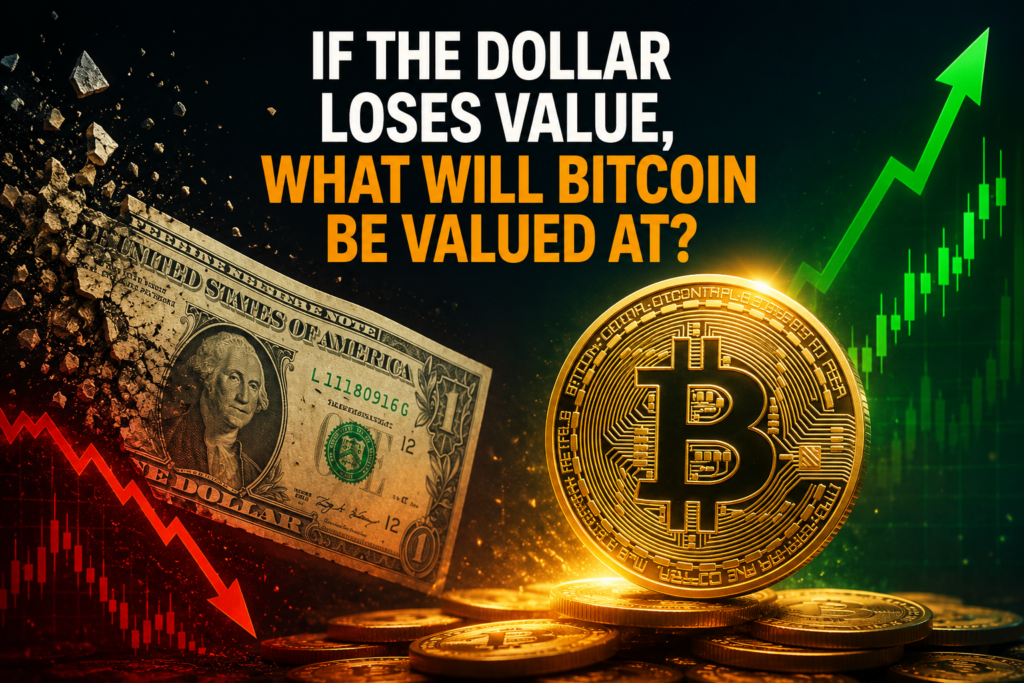
This brings us back to the main question. If Bitcoin is valued in dollars today, what happens when the dollar weakens? What is Bitcoin actually worth?
The answer is that the dollar is simply the measuring stick we currently use—and like any measuring stick, it can shrink. Money is ultimately a tool for exchanging real things: food, shelter, labor, land, and time. A house is worth a house. An hour of skilled work is worth an hour of skilled work. The number of dollars we attach to those things can change dramatically without the underlying reality changing at all.
Think of it this way: we measure distance in miles. If miles were abolished tomorrow, distance would still exist. We’d simply measure it in kilometers. The road doesn’t become longer or shorter. Only the label changes. The same principle applies to Bitcoin’s value. If the dollar weakens, it takes more dollars to buy the same Bitcoin—not because Bitcoin became more valuable, but because the dollar became less so.
This is why the most useful question about Bitcoin isn’t “how many dollars is it worth?” but rather “how much purchasing power does it preserve?” Those are completely unique questions, and the second one is far more honest.
Five Scenarios: What Bitcoin Looks Like as the Dollar Weakens
To make this concrete, it helps to walk through what Bitcoin’s role might look like under different degrees of dollar weakness.
Moderate inflation is the most likely scenario, and in many ways it’s already underway. If the dollar gradually loses half its purchasing power over the next decade, a house that costs $500,000 today might be listed at $1,000,000. Bitcoin, sitting at $100,000 today, might be $200,000. Your Bitcoin appears to have doubled—but it still buys roughly the same fraction of that house. The dollar price went up. The real value stayed the same. Purchasing power is the only metric that matters.
High inflation looks like what Argentina has experienced multiple times over the past few decades. Every day prices become almost unrecognizable—bread at $50, gas at $100 per gallon, houses in the millions. At that stage, people stop asking how much Bitcoin is worth in dollars and start asking how much food, fuel, or labor it can buy. The dollar becomes the unstable variable. Bitcoin becomes a more reliable reference point because it is predictably scarce, unlike dollars, even though it has imperfections.
Hyperinflation is the extreme end—where a loaf of bread costs $10,000, and the dollar price of anything becomes meaningless. History has given us vivid examples: Weimar Germany in the 1920s, Zimbabwe in the 2000s, Venezuela in the 2010s. In these environments, people naturally migrate toward more stable stores of value—gold, foreign currencies, commodities, and increasingly, Bitcoin. The conversation shifts from “Bitcoin is worth $100 million” to “a house costs 5 BTC” or “a car costs 0.1 BTC.” The dollar still technically exists, but nobody uses it to understand what things cost.
Bitcoin as a Global Reserve Asset is the scenario many long-term Bitcoiners are building toward. Instead of gold backing currencies or the dollar serving as the world’s reserve, Bitcoin becomes the neutral global reserve—held by countries, banks, and institutions. International trade settles in Bitcoin. Prices are quoted in Satoshi, Bitcoin’s smallest unit (one Bitcoin contains 100 million Satoshi). A coffee might cost 250 sats. A car might cost 5 million sats. A house might cost 300 million sats. No dollar conversion needed or wanted.
Everything priced in Bitcoin represents the most extreme scenario of all. Bitcoin’s ultimate value would be determined by its share of the world’s total wealth—real estate, stocks, bonds, gold, commodities, art, and everything else. If Bitcoin eventually absorbed even 10% of global wealth, then 21 million coins would collectively represent that purchasing power. The question would no longer be “how many dollars is Bitcoin worth?” but “what percentage of the world’s wealth does one Bitcoin represent?” That is arguably the most fundamental valuation model possible, and it suggests per-coin values far beyond what most people currently imagine.
But Why Bitcoin Specifically? Why Not Gold, or Something Else?
This is one of the most common and fair questions. Gold served as humanity’s monetary anchor for thousands of years. It’s scarce, durable, recognizable, and has no government controls on it. Why isn’t gold the answer?
Gold has a few genuine weaknesses in the modern world. It’s heavy and difficult to transport in large quantities. It’s difficult to divide precisely—you can’t easily send someone 0.00001 ounces of gold across the internet. It’s expensive to verify and store securely. And while gold supply is limited, it isn’t fixed—miners continue to pull new gold from the earth every year, slowly expanding the supply. Gold is excellent money, but it has physical limitations that make it awkward for a digital, globally connected economy.
Bitcoin addresses these weaknesses directly. It can be sent anywhere in the world in minutes, at any time, with no intermediary. It can be divided into 100 million units (satoshis), making it useful for transactions of any size. It can be verified instantly by anyone with a computer. It has no physical form to steal, seize, or destroy. Its supply is fixed, not merely limited—no miner can create new Bitcoin beyond what the protocol allows. And it can be stored in a way that makes it genuinely self-sovereign: with the right knowledge, you can hold your Bitcoin in a way that no government, bank, or third party can access or confiscate it.
This combination of properties—scarcity, divisibility, portability, verifiability, and self-sovereignty—is genuinely new in the history of money. Nothing before Bitcoin has had all of them simultaneously.
The Thought Experiment That Clarifies Everything
Here is the simplest way to test your understanding of Bitcoin’s value. Imagine every fiat currency disappearing tomorrow. No dollars. No euros. No yen. No government-issued money of any kind. What would 1 Bitcoin be worth?
The answer is: whatever people are willing to exchange for it. Perhaps 50 ounces of gold. Perhaps one-tenth of a house. Perhaps six months of skilled labor. Perhaps 10,000 pounds of wheat. Those become real exchange rates, and they reveal something important: Bitcoin’s purchasing power doesn’t disappear just because the measuring stick we currently use has changed. The value lies in what people are willing to give in exchange for it; it ultimately reflects the network’s real scarcity, utility, and trustworthiness.
Before the 1970s, many of the world’s currencies were measured against gold. People didn’t ask, “How much is gold worth?” They asked, “How much gold backs this currency?” Gold was the anchor, and currencies were measured against it. In a Bitcoin-standard future, people might ask “how much Bitcoin is this asset worth?” rather than “how many dollars?” We’re already beginning to see traces of this shift. Public companies hold Bitcoin on their balance sheets. Funds benchmark performance against Bitcoin. Some governments have begun holding it in reserve. If that trend continues for decades, Bitcoin may well become the benchmark asset that everyone else measures against.
What Happens to Other Cryptocurrencies?
Once you understand Bitcoin’s role as a monetary asset, it’s worth asking where the thousands of other cryptocurrencies fit in. The honest answer is that most are trying to solve different problems—and should be evaluated on different terms.
Bitcoin’s core value proposition is monetary: it’s a scarce, decentralized, self-sovereign store of value and medium of exchange. Its simplicity is a feature, not a limitation. The code changes slowly and deliberately because the qualities that make excellent money—predictability, reliability, and resistance to manipulation—require stability above all else.
Other networks like Ethereum compete on programmability: the ability to run decentralized applications, smart contracts, and financial protocols on top of a blockchain. These are genuinely useful things, but they serve a different purpose. They’re more like platforms than money. Whether they retain value long-term depends on whether people continue to use and trust those platforms.
In a Bitcoin-standard world, altcoins would likely be valued in BTC rather than in dollars. One ETH might be worth 0.025 BTC. One SOL might be worth 0.001 BTC. The honest question many Bitcoiners ask is simply, will this asset outperform Bitcoin over time? Most believe the answer, for most altcoins, is no—because none of them have Bitcoin’s combination of network size, decentralization, fixed supply, and ten-plus years of unbroken security. But opinions differ, and the market will ultimately decide.
Stablecoins occupy a unique position. Today, they’re mostly pegged to the dollar, designed to give people the ease of digital transactions without Bitcoin’s price volatility. If the dollar remains important, they’ll remain useful. But in a world where Bitcoin had become the primary monetary standard, dollar-backed stablecoins would become less necessary. You might instead see Bitcoin-backed stable products or tokens pegged to real-world baskets of goods—a unit of labor, a commodity index, an ounce of gold.
The Deeper Question: Why Does Any of This Matter to You?
If you’re reading this as an ordinary person—not a trader, not a tech enthusiast, just someone trying to protect what you’ve earned and build something for your family—here is why this conversation matters.
Every dollar you save is slowly losing purchasing power. This isn’t a conspiracy theory. It’s the stated goal of central bank policy. The U.S. Federal Reserve explicitly targets 2% inflation per year, meaning they intend for your dollar to buy 2% less each year than it did the year before. Over 35 years, that 2% target cuts the purchasing power of a dollar roughly in half. And in practice, the real inflation experienced by everyday people—in housing, food, healthcare, and education—tends to be considerably higher than the official figures suggest.
Gold has historically offered protection against this erosion. Real estate has too, though it comes with high barriers to entry. Bitcoin offers something new: a form of savings that is globally portable, infinitely divisible, impossible to inflate, and accessible to anyone with an internet connection and as little as a few dollars to invest. You don’t need to be wealthy to start. You don’t need a bank account, a broker, or anyone’s permission.
That doesn’t mean Bitcoin is without risk. It is volatile. Its future is not guaranteed. It is still early. Anyone who tells you it’s a sure thing is either confused or trying to sell you something. But the question worth sitting with isn’t “Is Bitcoin risky?” Everything is risky. The real question is: what are the risks of not holding any scarce assets at all while the currency you’re saving in loses value year after year?
A New Way of Thinking About Wealth
The most lasting shift Bitcoin tends to produce in people isn’t excitement about price. It’s a change in how they think about money itself. They start to notice inflation not as abstract statistics but as a personal reality. They start to ask not just, “Is this investment going up?” but “is this investment outpacing the debasement of the currency I’m measuring it in?” They start to think in terms of purchasing power rather than nominal dollars.
Once you start thinking that way, a $10 million Bitcoin stops sounding absurd—not because Bitcoin is magic, but because you understand that such a number might tell you more about the dollar than it does about Bitcoin. And a present-day price of $100,000 stops feeling expensive once you understand that you can buy a fraction of a Bitcoin for any amount you choose, and that you’re not betting on a number going up—you’re exchanging a depreciating currency for a fixed, scarce, globally recognized asset.
Bitcoin’s supply is permanently capped at 21 million coins, each worth 100 million satoshis. Across a world of eight billion people and centuries of potential use, that is not very much. Whether it becomes the dominant global reserve asset, a widely used savings tool, or something we can’t yet fully imagine, the underlying logic of why something scarce, portable, verifiable, and decentralized has value is not complicated. It’s the same logic that made gold valuable for five thousand years.
Bitcoin is just a version of that logic that works.