
Posted on Bitcoin4Newbies | Bitcoin News
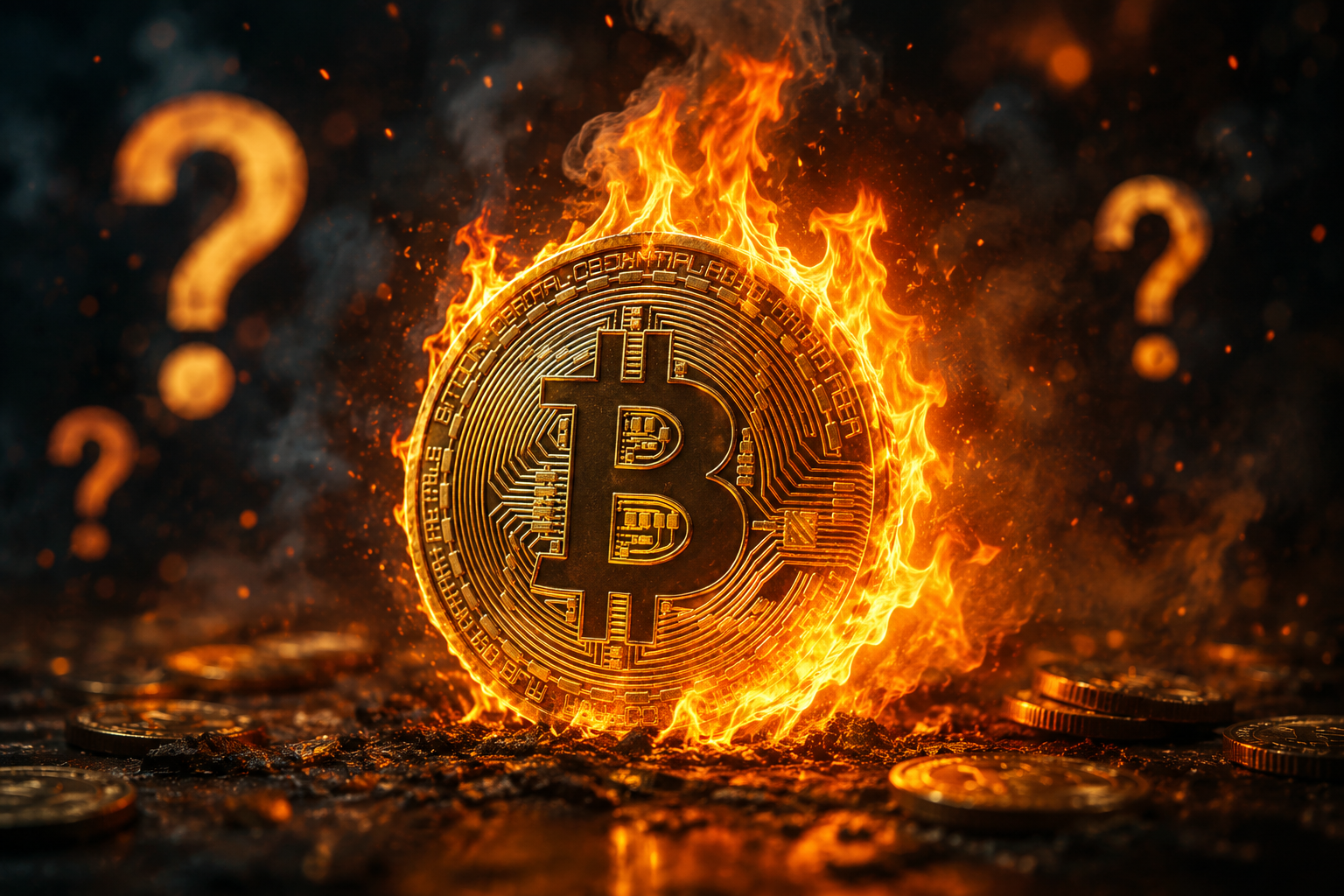
On May 25, 2026, something happened on the Bitcoin blockchain that shocked the crypto world. An unknown person — or entity — deliberately sent 107 Bitcoin, worth approximately $8.2 million, to a burn address, permanently destroying the funds. No explanation. No identity. No motive.
This isn’t a hack. This isn’t a theft. This is someone choosing to erase millions of dollars from existence — and the Bitcoin community can’t agree on why.
What Actually Happened
At 13:59 UTC on May 25, 2026, five separate transactions were confirmed in block 950,962 on the Bitcoin blockchain. Each transaction sent Bitcoin to the same destination: a well-known burn address.
1111111111111111111114oLvT2
The transactions sent Bitcoin in these batches:
- 20.02 BTC
- 36.78 BTC
- 28.88 BTC
- 1.41 BTC
- 20.02 BTC
Total: 107.13 BTC, worth approximately $8.2 to $8.5 million at Bitcoin’s price of $77,000–$80,000 at the time.
On-chain analyst Sani of TimechainIndex.com was the first to flag the unusual activity, noting that all five transactions were confirmed in the same block, a detail that strongly suggests this was no accident.
As Sani put it: “You don’t make the same mistake five times.”
What Is a Bitcoin Burn Address?
For newcomers, a burn address is a valid Bitcoin address with one critical difference: nobody has the private key to it.
Think of it like a safe deposit box with no combination. You can put things in, but nobody—not the sender, a bank, or a government—can take them out. The funds are gone permanently.
The specific address used, 1111111111111111111114oLvT2, was deliberately designed so that its public key consists entirely of zeroes. This approach makes it mathematically impossible to derive any private key — even in theory.
This burn address is no stranger to receiving Bitcoin. Before this event, it had already accumulated over 807 BTC, worth approximately $62 million, from more than 146,000 transactions dating back to at least 2015. After this latest transfer, the total locked in this address now stands at over 914 BTC, forever.
Where Did the Bitcoin Come From?
On-chain analysis traced the source funds to wallets connected to cryptocurrency exchanges — specifically, wallets that had previously interacted with Poloniex, Bitfinex, and Kraken. This is consistent with early Bitcoin adopters who were active in the 2014–2015 era.
Key details from on-chain data:
- The source wallet began accumulating Bitcoin in 2014
- Its balance peaked at approximately $2.5 million at the end of 2025
- The entire balance was then transferred to the burn address on May 25, 2026
- The sender used a timelock parameter, programming the transactions to execute automatically at block 950,958
- The sender also paid double the usual transaction fee to ensure the transactions would be included in the target block
This level of technical precision rules out a simple copy-paste error. Someone who knows how to set timelocks and overpay fees knows exactly what they’re doing.
The Theories: What Is Everyone Saying?
The Bitcoin community has been buzzing with speculation. Here are the leading theories:
Theory 1 — A Catastrophic Mistake The most straightforward explanation: someone made an incredibly expensive error. Perhaps they intended to send it to their wallet and copied the wrong address. However, the use of timelocks and five separate transactions in the same block makes this theory difficult to believe. Most analysts have ruled it out.
Theory 2 — A Deliberate Philosophical Statement Some in the Bitcoin community view burning coins as the ultimate act of belief in Bitcoin’s value—a permanent, irreversible commitment to the network’s scarcity. Destroying $8.2 million could be interpreted as a statement: “This amount is worth more to me destroyed than spent.”
Theory 3 — An AI Trading Agent Gone Wrong Several community members suggested that an automated trading bot or AI agent may have malfunctioned and executed the transactions without human intent. Given the increasing use of algorithmic Bitcoin management tools, this theory gained traction—though no evidence has emerged to support it.
Theory 4 — A Project Launch or Marketing Stunt. In January 2014, the Counterparty project famously required participants to burn Bitcoin to participate in its launch. Some speculate this burn may be the first signal of a new project announcement. So far, no organization has come forward.
Theory 5 — The “Accidental Quantum Bounty” Perhaps the most intriguing theory came from Adam Back, the CEO of Blockstream and one of the most respected figures in Bitcoin’s history. Back responded to the on-chain alert with a single phrase:
“Accidental quantum bounty?”
Back’s theory is fascinating and connects to one of Bitcoin’s most debated long-term threats. The burn address’s public key is all zeroes—meaning if a quantum computer ever becomes powerful enough to crack elliptic curve cryptography, that machine could theoretically derive the private key and claim the 914+ BTC locked inside. Back’s suggestion: whoever burned this Bitcoin may have inadvertently created a prize for whoever achieves that quantum computing breakthrough first.
The Quantum Computing Connection
Adam Back’s comment opens a much larger conversation—one that is increasingly relevant in 2026.
Quantum computing threatens the mathematical foundations that secure all public-key cryptography, including Bitcoin. While today’s quantum computers are nowhere near powerful enough to crack Bitcoin’s encryption, the timeline is compressing.
Caltech researchers recently found that Bitcoin may require far fewer qubits to crack than earlier models assumed. ARK Invest has outlined five stages of quantum risk for Bitcoin and estimates that approximately $480 billion in BTC could be at long-term risk due to publicly visible keys.
Bitcoin’s developers are already researching post-quantum cryptographic upgrades—but implementation timelines remain uncertain. The burn address, with its all-zero public key, sits at the center of this conversation. If quantum computing ever matures, the 914 BTC in that address becomes a theoretical prize.
What Does This Scenario Mean for Bitcoin’s Price and Supply?
Let’s be direct: 107 BTC will not move Bitcoin’s price.
Bitcoin’s circulating supply is approximately 19.7 million coins. Removing 107 BTC represents roughly 0.0005% of the total supply — a negligible fraction. Markets barely reacted to the news.
However, the broader context matters for Bitcoin holders:
- Bitcoin has a fixed maximum supply of 21 million coins
- An estimated 3 to 4 million BTC are already permanently lost through forgotten wallets, lost private keys, and burn events
- Every Bitcoin permanently removed from circulation very slightly increases the scarcity of all remaining coins
- The burn address now holds over 914 BTC—worth $62+ million—all permanently unspendable
Over a sufficiently long time horizon, the cumulative effect of lost and burned Bitcoin does tighten supply. But this single event? Negligible near-term impact.
What About the Original Purchase Price?
This is where the story gets particularly compelling for long-term Bitcoin holders.
The source wallets began accumulating Bitcoin in 2014. At that time, Bitcoin was trading between approximately $300 and $800 per coin. If the 107 BTC were accumulated at an average cost of around $500 per coin, the original cost basis would have been roughly:
107 BTC × $500 = approximately $53,500
Those same coins were worth $8.2 million when they were burned.
In other words, whoever burned this Bitcoin may have sat on a 15,000%+ gain and chose to destroy it rather than sell it. That is either the most expensive philosophical statement in Bitcoin history or the most expensive mistake.
What Does This Mean for Miner Fees?
This distinction is a nuanced point worth understanding for Bitcoin newbies.
Bitcoin miners earn revenue in two ways: the block subsidy (newly created BTC) and transaction fees. As Bitcoin approaches its maximum supply and block subsidies continue to halve, transaction fees become increasingly important to miners’ income.
The burn transactions themselves paid approximately double the standard fee rate — meaning the sender deliberately overpaid to ensure inclusion. This is a minor but real contribution to miner revenue.
The longer-term implication is that as more Bitcoin permanently gets lost or burned, the effective circulating supply tightens. In a world where demand grows but supply shrinks, fee pressure on the remaining UTXOs increases. Every transaction competes for block space, and with fewer spendable coins in circulation, each remaining UTXO becomes marginally more valuable.
For holders who understand UTXOs, this is exactly why tracking your coins, knowing their origin, and managing your wallet structure matters. The coins you hold today are increasingly scarce in a world where some holders are literally burning theirs.
The Bottom Line for Bitcoin Newbies
Here is what this event means in plain English:
- Bitcoin transactions are irreversible. There is no customer service, no undo button, and no refund. A wrong address is permanent. This event is an $8.2 million reminder of that fact.
- Bitcoin’s scarcity is real and growing. Between lost wallets, forgotten keys, and deliberate burns, the number of truly accessible Bitcoins continues to shrink below the 21 million cap.
- Nobody controls Bitcoin. No authority can reverse this process. No institution can retrieve the funds. This is Bitcoin working exactly as designed.
- Quantum computing is a real conversation. Adam Back’s comment wasn’t a joke—it reflects genuine ongoing debate among Bitcoin’s brightest minds about the long-term security of public-key cryptography.
- Your UTXOs matter. Know what you own, where it came from, and how to keep it safe. The person who burned $8.2 million presumably knew what they were doing and did it anyway.
Want to track your Bitcoin UTXOs properly? Download our free Bitcoin4Newbies UTXO Tracker — and if you want to go deeper, check out The Jar on the Counter: A Beginner’s Guide to Bitcoin UTXOs.
👉 Download Free UTXO Tracker 👉 Order a Signed Copy of The Jar on the Counter — $24.99 👉 Buy on Amazon
Sources: CryptoBriefing, CryptoTimes, BeInCrypto, Cryptopolitan, Bitcoin Foundation, KuCoin, MEXC, OurCryptoTalk, Protos, Bitcoin.com